






Koszyk
W koszyku nie ma jeszcze produktów
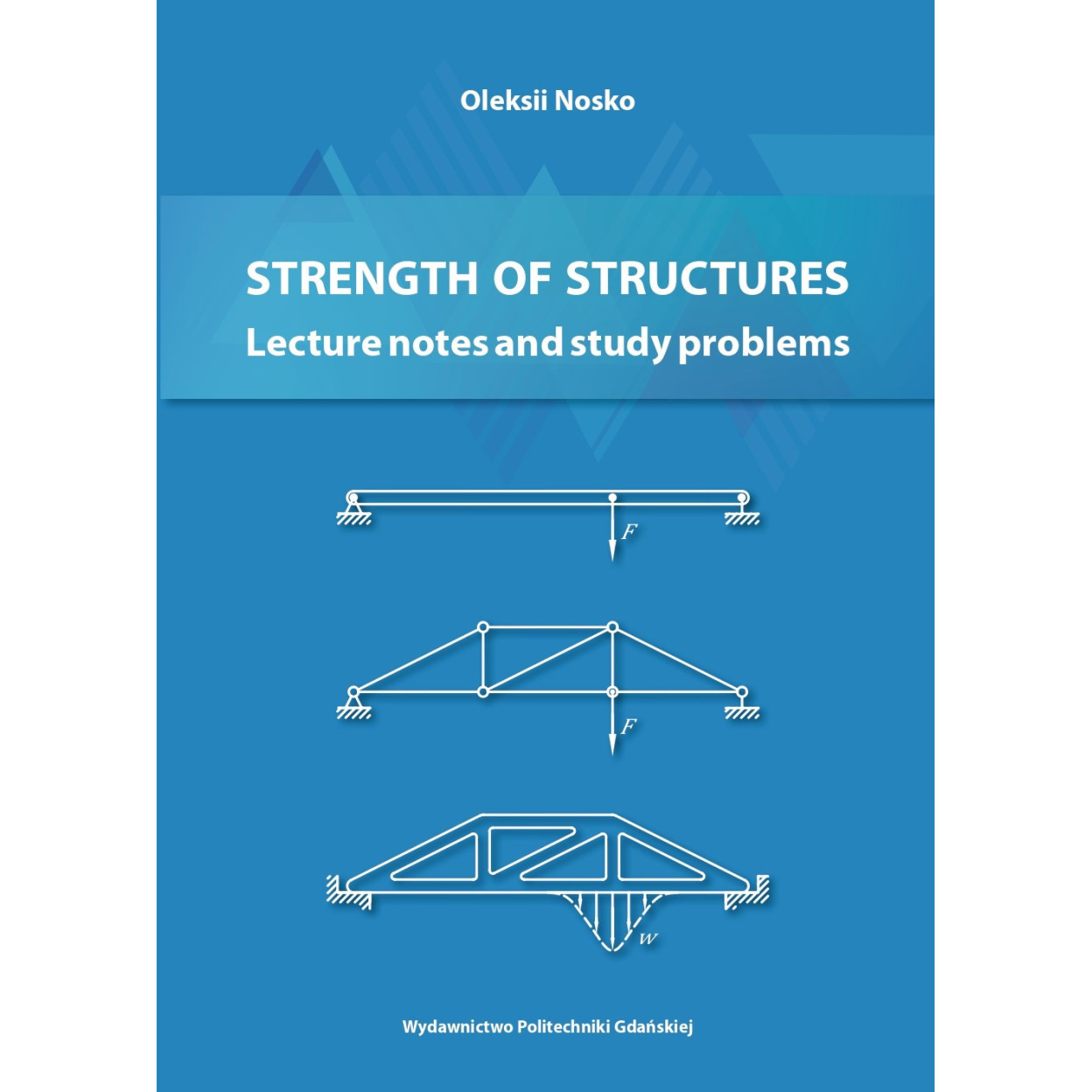
This book is a collection of lecture notes and study problems on the subject of Strength of Materials, also known as Mechanics of Materials or Mechanics of Deformable Bodies. It is designed to teach students the most important terms, assumptions, principles and methods of the subject.
The content of the book is organised in the form of ten lectures. Lectures 1–6 are dedicated to the problems of tension, compression, torsion and bending. Lectures 7‒8 deal with the problems of plane stress under combined loading. Lectures 9–10 introduce the energy methods for solving statically determinate and indeterminate problems.
Before taking the course of Strength of Materials, students should have completed a course of Mechanics. In particular, they are expected to know and be able to apply the conditions of static equilibrium and the principles of conservation of energy. Since the solution of study problems requires the application of the methods of differential and integral calculus, students should also have completed a course of Mathematical Analysis.
The focus of the book is to help students develop the skills to efficiently schematise, solve and analyse the typical problems of the subject. The study problems considered are categorised into twenty groups P1–P20, each of which is assigned to a specific lecture. The study problems are formulated both in ‘classical’ form, when the aim is to determine an internal force, displacement, stress or strain in a structure under the action of certain loads, and in ‘engineering’ form, when the aim is to determine the maximum loads or minimum geometric sizes for which the structure retains its load-carrying capacity. The book contains all algorithms and formulae required to solve the study problems. Nonetheless, it should be considered as a basic introduction to the subject. Systematic reading of the comprehensive textbooks, e.g. [1−5], is necessary for a deeper understanding of the subject.
ADDITIONAL MATERIALS
Artificial Intelligence
P9: 1, 2, 3, 4, 5, 6, 7, 8, 9, 10
P10: 1, 2, 3, 4, 5, 6, 7, 8, 9, 10
Finite Element Method (FEM)